A coastal cliff is not a permanent viewing platform. Along the Baltic shore, erosion, water and natural woodland processes alter both the slope and the paths above it. A photograph or an old walking map cannot establish whether a route is suitable today. The useful questions are whether the proposed path is currently open and where you can turn back without approaching the edge.
Follow the marked route
In Jasmund National Park, the marked clifftop trail keeps its distance from the cliff edge. The park authority explicitly warns that chalk can collapse in any weather. Sunshine following several dry days is therefore not an all-clear. Stay on the designated trail even where a narrow informal path appears to lead to a better photograph. Footprints demonstrate neither permission nor ground stability.
A travel article cannot prescribe a universally safe distance in metres. Undercutting may be invisible from above. Signs, barriers and the official alignment of the path take precedence over your own estimate. A tree growing near the edge is not a reliable handhold either. Explain the boundary to children before reaching the first viewpoint, rather than beginning that conversation beside the drop.
The beach is not an alternative clifftop route
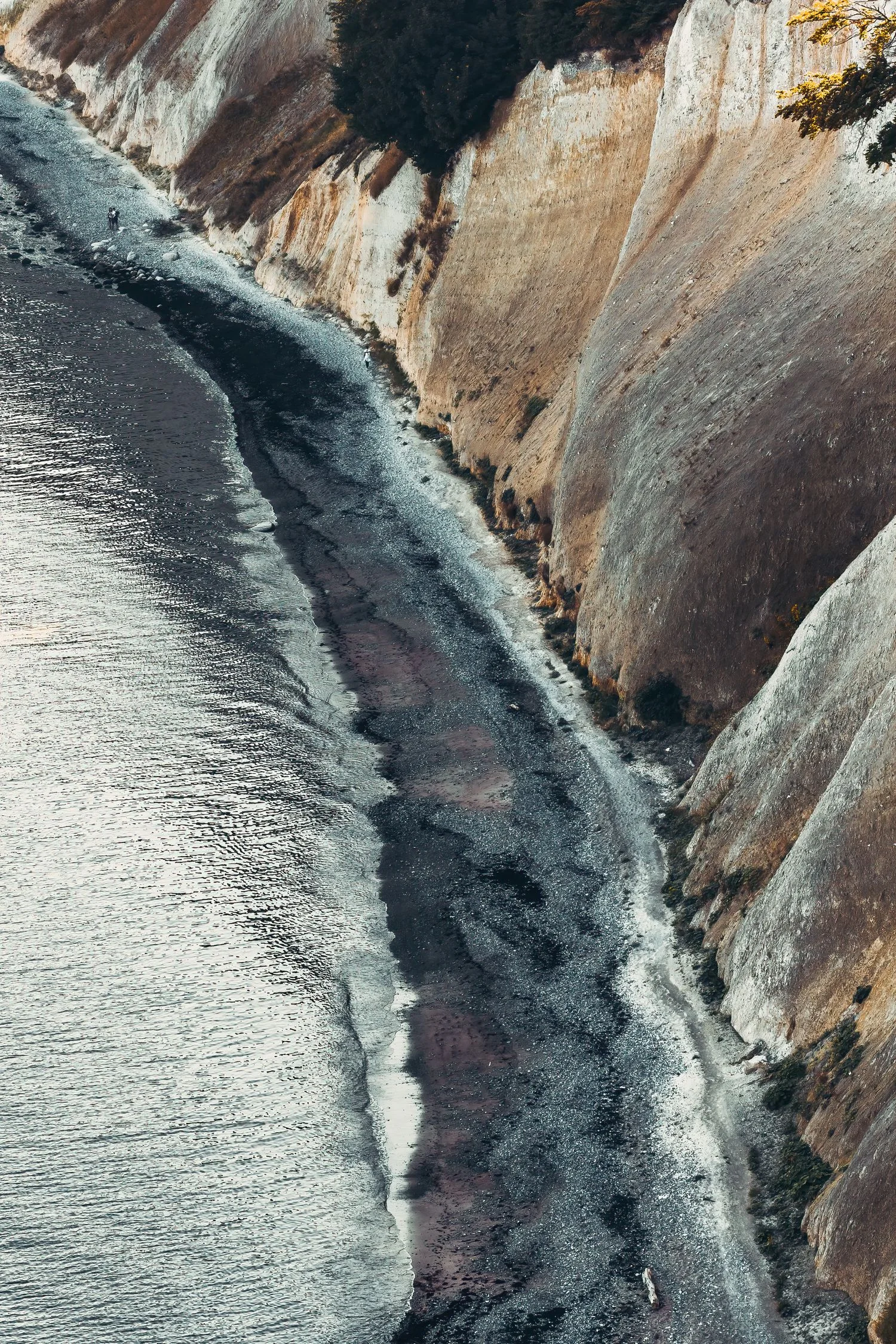
Do not bypass a closed upper trail by walking beneath the cliff. Stones, chalk and trees can fall onto that shore. Park guidance advises avoiding the stony beach below the chalk coast. What looks like a shortcut between two stairways may also end at a missing or closed ascent, leaving no straightforward onward route.
Before setting out, check an official map and current access notices. Identify the last clearly permitted junction where a shorter walk is possible. If you encounter a closure, return to that junction rather than searching for another way around the slope. The extra distance is a reason to retain time and energy in reserve from the start.
Carry a charged phone, but do not treat reception or a location display as a substitute for understanding the route. Signed orientation points within the national park can help describe your position in an emergency. Strong wind also makes woodland an unsuitable automatic fallback because branches may fall. On such a day, a visit to an open information centre or a different weather-appropriate activity is a more sensible replacement for the cliff walk.